SWOT Analysis

Strengths, Weaknesses, Opportunities and Threats (SWOT).

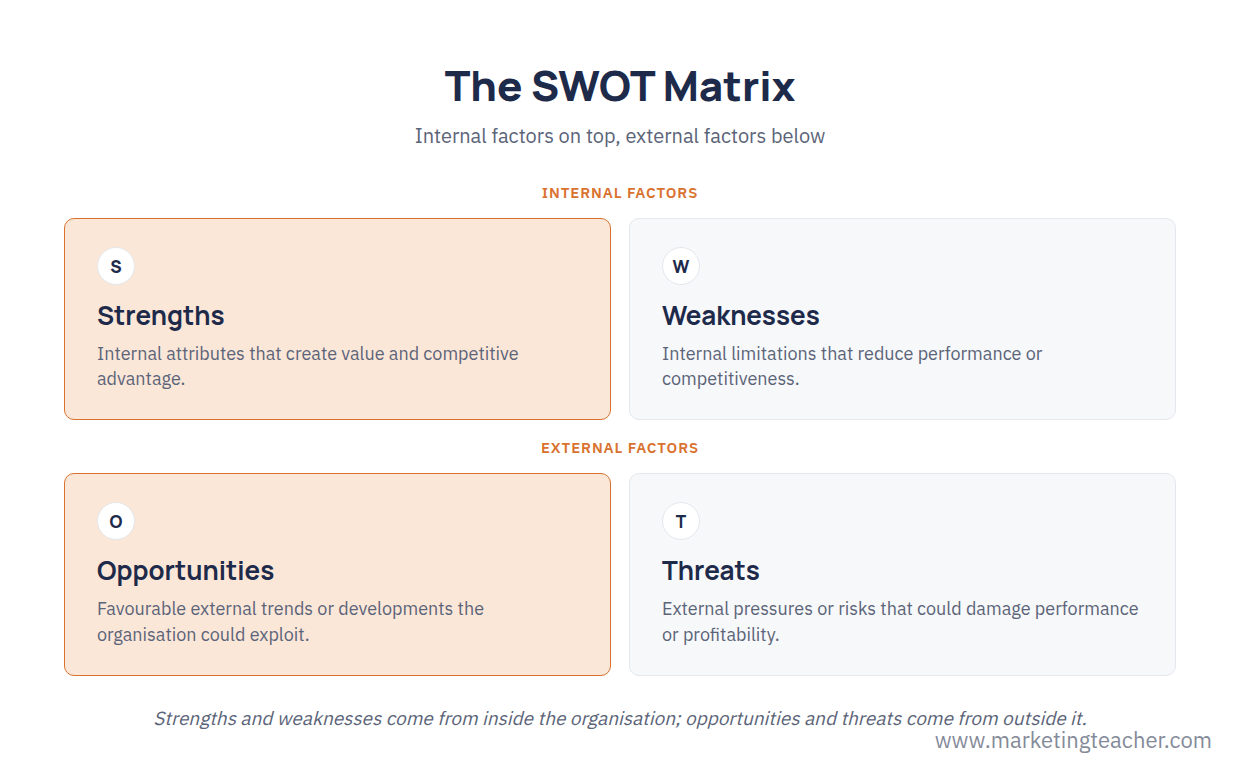
SWOT analysis is a tool for auditing an organization and its environment. It is the first stage of planning and helps marketers to focus on key issues. SWOT stands for strengths, weaknesses, opportunities, and threats. Strengths and weaknesses are internal factors. Opportunities and threats are external factors.

Example 1 (quick) - In SWOT, strengths and weaknesses are internal factors.

For example:A strength could be:

  • Your specialist marketing expertise.
  • A new, innovative product or service.
  • Location of your business.
  • Quality processes and procedures.
  • Any other aspect of your business that adds value to your product or service.

A weakness could be:

  • Lack of marketing expertise.
  • Undifferentiated products or services (i.e. in relation to your competitors).
  • Location of your business.
  • Poor quality goods or services.
  • Damaged reputation.

SWOT Video


To watch the full SWOT Analysis video please register free here

In SWOT, opportunities and threats are external factors.

For example: An opportunity could be:

  • A developing market such as the Internet.
  • Mergers, joint ventures or strategic alliances.
  • Moving into new market segments that offer improved profits.
  • A new international market.
  • A market vacated by an ineffective competitor.

A threat could be:

  • A new competitor in your home market.
  • Price wars with competitors.
  • A competitor has a new, innovative product or service.
  • Competitors have superior access to channels of distribution.
  • Taxation is introduced on your product or service.

Example 2 (click on the links for more detail) - In SWOT, strengths and weaknesses are internal factors.

For example:

A strength could be:

  • Customer Relationship Management (CRM) and Information Technology (IT) support Amazon's business strategy.
  • Toys "R" Us has in excess of 1500 superstores in the United States and Worldwide.
  • Brand is all-important. Apple is one of the most established and healthy IT brands in the World.
  • Wal-Mart has grown substantially over recent years, and has experienced global expansion (for example its purchase of the United Kingdom based retailer ASDA).
  • Ben and Jerry's is a prestigious, established, successful, global operation, with sales in USA, Europe and Asia, which is synonymous with social responsibility and environmentalism.
  • Stakeholders in Bharti Airtel include Sony-Ericsson, Nokia - and Sing Tel, with whom they hold a strategic alliance.
  • Williams-Sonoma has an extensive store network helps it cater to a varied consumer needs and segments and create product awareness and loyalty.
  • Among Fast Food restaurant chains, Burger King is second only to McDonalds and holds a 15% share of the United States market.
  • Whole Foods have had 25 years of double digit revenue growth.
  • Carnival Cruises are such a large company that they have significant cost advantages over most of their competitors.

A weakness could be:

  • China Mobile is not globally diversified. Telecoms companies tend to trade in more than one country.
  • Toyota needs to keep producing cars in order to retain its operational efficiency.
  • Because they are most well known for children's art products, they have yet to achieve high market share in this division, and most art professionals do not use Crayola products.
  • A slumping US economy may negatively impact demand for the Time Warner’s products and services.
  • Dell is a computer maker, not a compute manufacturer.
  • In the recent past the company's passenger car products are based upon 3rd and 4th generation platforms, which put Tata Motors Limited at a disadvantage with competing car manufacturers.
  • DreamWorks' stock price fell following lower than expected box office revenue for “How to Train Your Dragon”.
  • Starbucks has a reputation for new product development and creativity.
  • The software of EA Games is dependent upon the platforms that are created by other companies,
  • Sony's production facilities are located far from its customer base.

In SWOT, opportunities and threats are external factors.

For example:

An opportunity could be:

  • New and emerging markets provide opportunities for eBay in countries such as China and India.
  • To diversify and add breadth to its brand, Smith and Wesson licenses its name to makers of apparel, watches, sunglasses, gift sets, and more.
  • Sandals could promote their resorts at all Bridal and Child/Baby Expos in major cities, in order to reach the largest numbers of their target market.
  • Fox Entertainment is well positioned to capitalize on the shift to digital television
  • PepsiCo is in the midst of making a $1, 000 million investment in China, and a $500 million investment in India.
  • More than half of General Electric's revenues come from outside the United States, other contracting opportunities will take place in Mexico, South Africa, India, Italy, and Japan.
  • There are positive projects for General Motors' business in China and India.
  • Product development offers Nike many opportunities. The brand is fiercely defended by its owners whom truly believe that Nike is not a fashion brand.
  • The increasing demand for cloud computing is likely to create demand for HP’s solutions in coming years.
  • Open Nestlé Café's in major cities to feature Nestlé products.

A threat could be:

  • Home Depot joins competitors such as Lowes and Menards in taking a second look at expansion plans due to an uncertain economy.
  • Top competitors for Molson Coors include: Ashai, Carlsberg, Heineken, Kirin, and Tsingtao.
  • The most highly priced Indian Premier League teams may not be those that have the early success.
  • McDonald's have been criticized by many parent advocate groups for their marketing practices towards children which are seen as marginally ethical.
  • The supply chain has very few suppliers, leaving IBM very little to negotiate with or switch to.
  • The majority of the Kroger’s 326,000 employees are covered by collective labor agreements.
  • The customers of Infosys may switch to other offshore service companies in other countries such as China or Korea.
  • Many of Johnson and Johnson's new launch products are vulnerable to the uncertainty of regulatory review
  • The obvious threat is from ITC's competition, both domestic and international.
  • There may be religious, cultural and social restrictions among certain groups that object to utilizing Trojan's birth control methods.
SWOT Analysis

More great FREE SWOT stuff

Simple rules for successful SWOT analysis.

  • Be realistic about the strengths and weaknesses of your organization when conducting SWOT analysis.
  • SWOT analysis should distinguish between where your organization is today, and where it could be in the future.
  • SWOT should always be specific. Avoid grey areas.
  • Always apply SWOT in relation to your competition i.e. better than or worse than your competition.
  • Keep your SWOT short and simple. Avoid complexity and over analysis
  • SWOT is subjective.

Once key issues have been identified with your SWOT analysis, they feed into marketing objectives. SWOT can be used in conjunction with other tools for audit and analysis, such as PEST analysis and Porter's Five-Forces analysis. So SWOT is a very popular tool with marketing students because it is quick and easy to learn. During the SWOT exercise, list factors in the relevant boxes. It's that simple. Below are some FREE examples of SWOT analysis - click to go straight to them

A word of caution - SWOT analysis can be very subjective. Do not rely on SWOT too much. Two people rarely come-up with the same final version of SWOT. TOWS analysis is extremely similar. It simply looks at the negative factors first in order to turn them into positive factors. So use SWOT as guide and not a prescription.

Do you need a more advanced SWOT Analysis?

Some of the problems that you may encounter with SWOT are as a result of one of its key benefits i.e. its flexibility. Since SWOT analysis can be used in a variety of scenarios, it has to be flexible. However this can lead to a number of anomalies. Problems with basic SWOT analysis can be addressed using a more critical POWER SWOT.

The Real SWOT

SWOT as taught is today’s business schools is little more than Scientific Wild Ass Guess (SWAGs) according to Cranfield’s Professor Malcolm McDonald. He makes the point that many threats are the same regardless of the business environment that is being audited. For example, common-all-garden threats would include the weather, competitors, changes in technology, regulation and deregulation, and the impacts of competing countries. In strengths you’ll get good products – but that could mean anything. Under weaknesses you get equally general and vacuous points such as the price is too high. This type of SWOT analysis is too general and is not much use to marketing managers. SWOT needs to be segment specific. SWOT should look at groups of customers and their perception of your brand, what price they will pay, the place where they buy it, the products that they buy and so on. Otherwise your SWOT analysis is averaged and not specific.

SWOT analysis should be focused upon a segment of the market. Then you can ask – what are the Critical Success Factors(CSFs) that are pivotal to the buyer decision process – in that segment? Then you need to weight the CSFs so that you can separate those drivers that are most important. When considering strengths and weaknesses, in true marketing fashion you need to take the consumers’ perspective when completing the SWOT. You also must factor in the customers’ view of your business in relation to the competition i.e. relative to competitors. So you can match key CSFs to opportunities. You can rank those opportunities that are most profitable or sustainable. Then you need to factor in the impact of threats. Finally you should dovetail SWOT with the rest of your strategic thinking.

History of SWOT Analysis

Having arrived on this page you have probably surfed the Internet and scoured books and journals in search of the history of SWOT Analysis. The simple answer to the question What is SWOT? is that there is no simple answer, and one needs to demonstrate a little academic wisdom in that nobody took the trouble to write the first definitive journal paper or book that announced the birth of SWOT Analysis. There are a number of contrasting, if not contradictory views on the origin of SWOT. Here are a few of the leading thinkers on the topic (and if you have more please let us know so that we can add them). More . . .