
Why Does a Marketing Plan Need Controls?
There is no planning without control. Marketing control is the process of monitoring a plan as it proceeds and adjusting it where necessary. If an objective states where a business wants to be and a marketing plan sets out the route to get there, control is what tells the business whether it is on that route, drifting off it, or has already arrived. Kotler and Armstrong (2018) treat control as the final, essential stage of the planning process precisely because resources are scarce and costly: a business that spends a budget without checking whether it is achieving anything has no way of correcting course before the money is gone.
The Basic Control Cycle
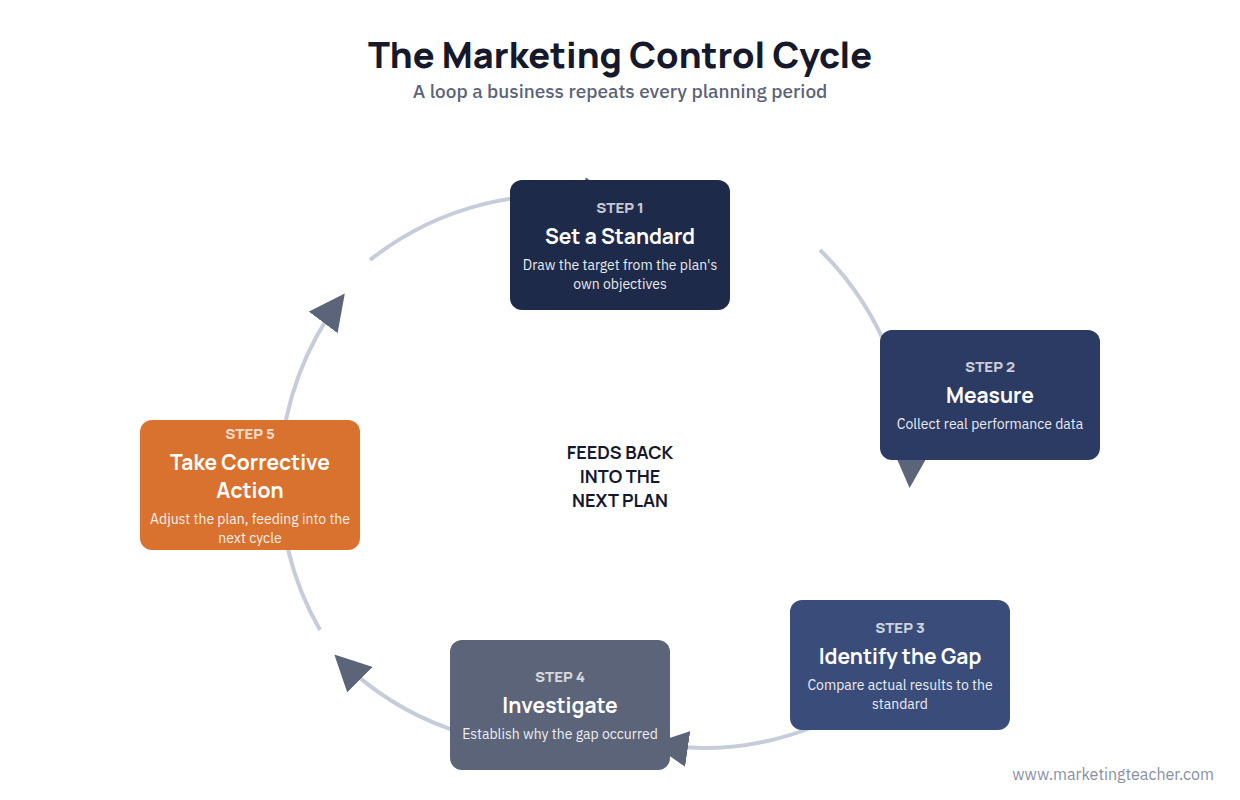
Control follows a simple, repeating cycle: set a standard, measure actual performance against it, and take corrective action where a meaningful gap appears. The standard usually comes straight from the plan’s own objectives, a sales target, a market share figure, a customer satisfaction score, or a spending limit. Measurement means collecting real data on what actually happened, not relying on impressions or anecdote. When a gap between the standard and the actual result shows up, the next step is not to panic and change everything, but to investigate why the gap occurred before deciding what, if anything, to change. A shortfall caused by a one-off supply problem calls for a different response than one caused by a competitor’s new product, and treating every gap as if it had the same cause is one of the most common ways a control system does more harm than good, cutting a budget or abandoning a channel that was never actually the problem.
Common Methods of Marketing Control
Businesses draw on a range of tools to run this cycle in practice. Sales analysis and market share analysis compare actual results against targets and against competitors. Marketing research and customer satisfaction surveys capture how customers are actually experiencing the marketing, not just what they buy. A marketing budget gives spending controls something concrete to check actual costs against, and a marketing information system pulls the resulting data together in one place so managers are not chasing numbers from several disconnected sources. A periodic marketing audit is the most thorough version of this checking process, examining the whole marketing function rather than one campaign, and is normally run less often than the routine monthly or quarterly checks described above precisely because of the depth involved. No single method is sufficient on its own: a sales figure alone cannot say whether a shortfall reflects weak marketing or a market that shrank for everyone, which is exactly why most businesses run several of these methods side by side rather than relying on one number to tell the whole story.
Control Feeds Back Into the Next Plan
The most easily missed part of marketing control is that it is not a one-way check performed at the end of a campaign. What control reveals, a channel that underperformed, an objective that turned out to be unrealistic, a segment that responded better than expected, becomes an input into the next planning cycle. This is why marketing planning is better understood as a loop a business returns to every period rather than a document produced once and filed away: control closes the loop, and its findings are exactly what the next situation analysis should start from. A business that treats each planning period as a fresh start, ignoring what the previous period’s controls actually found, ends up repeating the same avoidable mistakes rather than genuinely improving from one cycle to the next.
Summary
Marketing control means setting a standard, measuring actual performance against it, investigating any meaningful gap, and taking corrective action, all built into a marketing plan from the start rather than added on afterwards (Kotler & Armstrong, 2018). Sales and market share analysis, customer research, budget tracking, and periodic marketing audits are the main tools businesses use to run this cycle. What control finds should always feed back into the next planning period, which is what keeps a marketing plan a living system rather than a document written once and never revisited.

