What Is TOWS Analysis?
TOWS analysis is a strategic planning tool that takes the four factors identified in a SWOT analysis — Strengths, Weaknesses, Opportunities, and Threats — and systematically pairs the internal factors (strengths and weaknesses) against the external factors (opportunities and threats) to generate specific, actionable strategies. It was developed by Heinz Weihrich (1982) as a direct response to a common criticism of SWOT: that it is good at listing factors but offers little guidance on what to actually do with them.
When to Use TOWS
TOWS is a second step, not a replacement for SWOT. The usual sequence is to complete a SWOT audit first, gathering and agreeing the strengths, weaknesses, opportunities and threats a business actually faces, and only then build the TOWS matrix from those confirmed factors. Building a TOWS matrix without a SWOT audit behind it means the “factors” going into it are just guesses, and the strategies that come out are only as reliable as those guesses. TOWS can be applied at any level of a business — a single product line, a department, or the whole organisation — as long as the SWOT factors feeding into it were gathered at that same level, so the pairings stay meaningful rather than mixing company-wide threats with product-specific strengths.
Internal and External Factors
Strengths and weaknesses are internal factors — things the business controls directly, such as its brand reputation, cost base, staff skills, or product quality. Opportunities and threats are external factors — things happening in the market or environment that the business does not control, such as a competitor’s move, a shift in regulation, or a change in customer demand. Weihrich (1982) argued that useful strategy comes from deliberately crossing these two categories, rather than analysing each in isolation, which is exactly what the TOWS matrix forces you to do.
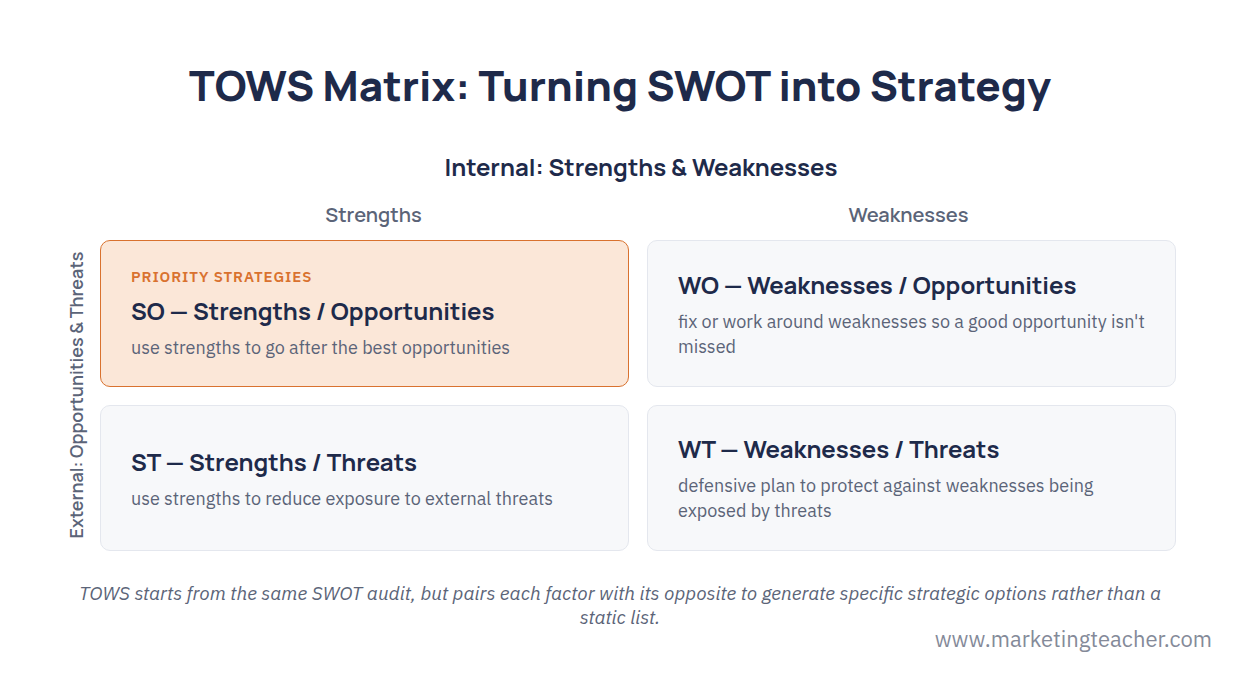
The Four TOWS Strategies
Strength/Opportunity (SO). Use an internal strength to take advantage of an external opportunity. These are usually the most attractive strategies, since they build on what the business already does well.
Weakness/Opportunity (WO). Use an external opportunity to overcome an internal weakness — often by investing, partnering, or hiring to close the gap so the opportunity isn’t missed.
Strength/Threat (ST). Use an internal strength to reduce or avoid the impact of an external threat, defending the business’s position rather than growing it.
Weakness/Threat (WT). A defensive strategy aimed at minimising damage where an internal weakness leaves the business exposed to an external threat — sometimes this means retreating from a market or product line altogether.
A real business rarely has just one relevant strategy. Several SO, WO, ST and WT strategies can apply at the same time, and part of the analysis is judging which combinations deserve the resources to act on.
TOWS Analysis – Simple Rules
A TOWS matrix on its own is only as good as the judgement behind it, so keep these five rules in mind when you build one:
- Start from a completed, agreed SWOT audit — don’t invent factors as you build the matrix.
- Be specific. “Strong brand” is too vague to pair usefully; “highest customer satisfaction score in the category” can be paired with a specific opportunity or threat.
- Not every factor needs to appear in every quadrant — some strengths only matter against certain threats, and that’s fine.
- Cross-check the resulting strategies against tools like Ansoff’s Matrix or Porter’s Generic Strategies to see whether they fit the business’s broader direction.
- Revisit the matrix periodically — Weihrich (1982) noted that both internal and external factors shift over time, so a TOWS analysis is a snapshot, not a permanent fixture.
Summary
TOWS analysis extends SWOT by forcing internal factors (strengths, weaknesses) to be paired against external factors (opportunities, threats), producing four types of strategy: SO, WO, ST and WT. It only works well when it is built on a properly completed SWOT audit, kept specific rather than vague, and revisited as circumstances change.