
What Is a Marketing Audit?
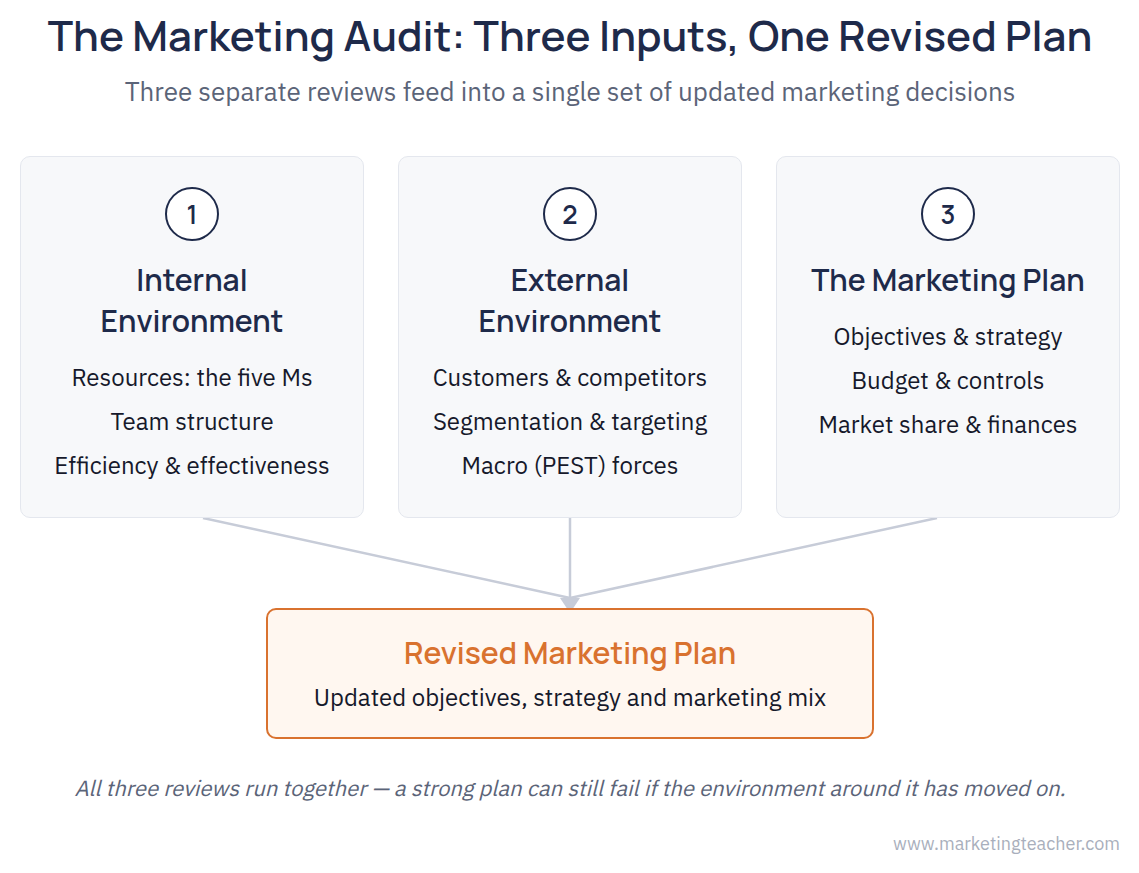
A marketing audit is a comprehensive, systematic and periodic examination of a business’s marketing environment, objectives, strategies and activities, carried out to identify problem areas and opportunities and to recommend a plan of action for improving marketing performance (Kotler, Gregor and Rodgers, 1977). Kotler and Armstrong (2018) place the audit inside the wider marketing control process: a business sets objectives, measures performance against them, and periodically steps back to check whether those objectives and strategies still fit a changing environment. That last part is what separates an audit from routine performance reporting. Reporting usually checks only whether current targets are being hit; an audit questions the targets and the thinking behind them, looks independently rather than defensively at what it finds, and runs on a regular schedule rather than only after something has gone wrong.
The Internal Marketing Environment
The first part of an audit looks inward, starting with the resources a business has to work with, often summarised as five Ms: labour, money, machinery, minutes (time) and materials. Alongside resources, an internal audit asks how the marketing team itself is organised, how efficiently and effectively it operates, and how well it works with other departments and with systems such as customer relationship management. A business can have talented staff and a healthy budget and still under-perform if the team is structured around last year’s priorities or if departments are not sharing information.
Who Should Carry Out the Audit?
Kotler, Gregor and Rodgers (1977) note that a marketing audit can be run by several different people, from a manager auditing their own department to a specially formed task force to an outside consultant with no stake in the results. Self-audits are cheap and fast, but the person marking their own work tends to miss the very assumptions the audit is meant to test. An outside auditor costs more and takes longer to brief, but brings genuine independence, comparisons with other businesses, and the confidence to challenge decisions that an internal team may be too close to question. Many mid-sized businesses settle for a middle path: an internal cross-functional task force that reports its findings to senior management rather than to the marketing department it is reviewing, trading some independence for speed and lower cost.
The External Marketing Environment
Looking outward starts with the customer: their needs and how well the business satisfies them, their buyer decision process and behaviour, their perception of and loyalty to the brand, how segmentation, targeting and positioning are working in practice, and what customers actually value. It continues with competitors: how profitable they are, how many there are and how concentrated the market is, their relative strengths and weaknesses, and what their own marketing plans appear to be. Finally, it takes in the wider macro-environment, the economic, social, technological and political or legal forces a PEST analysis is built to capture, since none of these factors sit still for long.
Reviewing the Marketing Plan Itself
The third area turns the audit back onto the plan the business is already running. Are the current objectives still realistic, and were they SMART to begin with? Are the chosen strategies and the marketing mix actually being applied as intended? Is the plan being controlled effectively, with a proper feedback loop between results and decisions? Is the marketing budget being achieved, and is the team resourced, trained and experienced enough to deliver what the plan asks of it? Finally, the numbers: market share by product, customer and channel, and financial performance measured through profit margins, cash flow and ratios such as the debt-to-equity ratio.
Summary
A marketing audit is a structured, independent and regular review of a business’s internal resources, its external customers, competitors and macro-environment, and the marketing plan it is currently running. Tools such as SWOT analysis, PEST analysis and Five Forces analysis are commonly used to carry out parts of the audit, and its findings feed back into the objectives and strategies covered in marketing planning and marketing controls.

The slides, worksheet, lesson plan and poster for this lesson are free to download and free to use in your course — no sign-up, no permission needed. See the teacher resources →
Assign this lesson to your class:
Using Canvas, Blackboard or Moodle? Copy the link and paste it into your course page or assignment. More ways to add lessons to your LMS.

