
What Is the Marketing Environment?
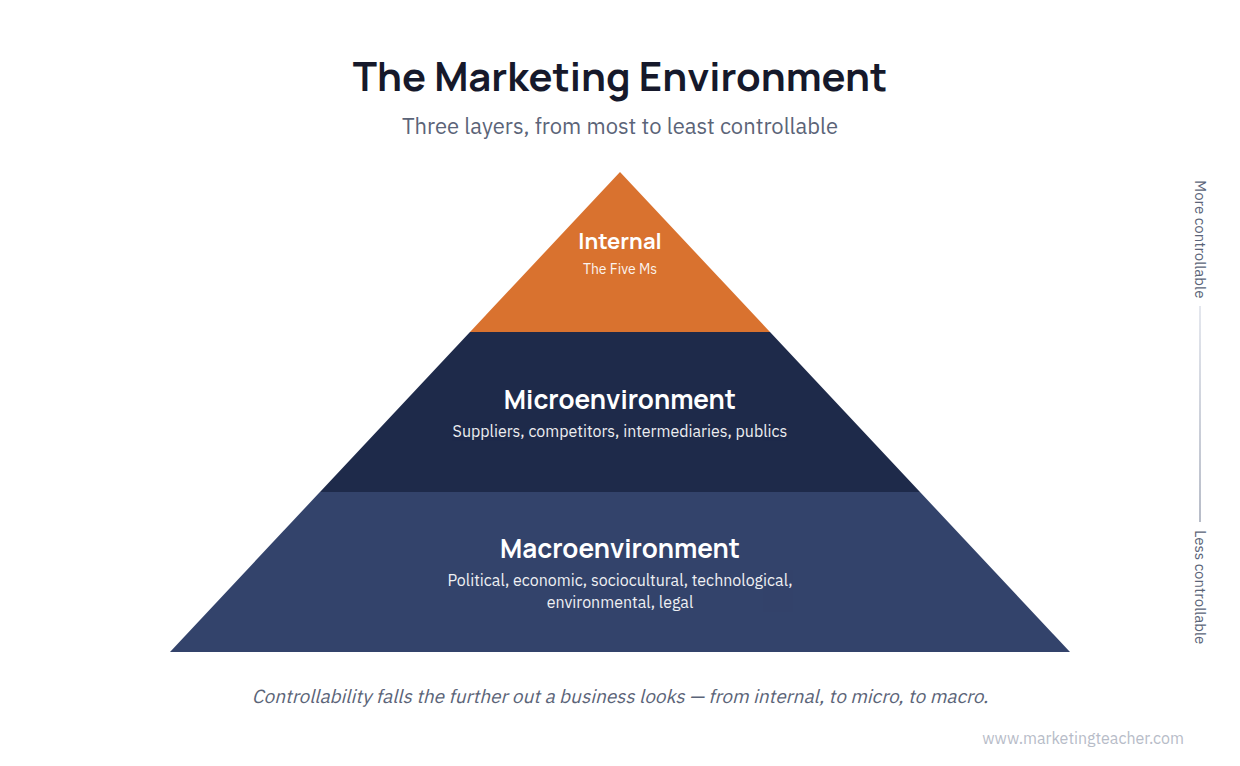
The marketing environment is everything that surrounds a business and shapes the decisions it can make. Kotler and Armstrong (2018) split it into three layers: the internal environment (the business itself), the microenvironment (the players close enough to affect the customer relationship directly), and the macroenvironment (the broad societal forces no single business controls). Moving from internal to macro, a business has progressively less control: it can change its own staffing and processes outright, it can influence but not dictate how suppliers and competitors behave, and it can only monitor and adapt to shifts in the wider economy, technology or law. Marketers scan all three layers because a decision that looks sound against one layer can still fail against another.
The Internal Environment: Auditing With the Five Ms
The internal environment covers everything within the business’s own walls: its people, its finances, its equipment, and its own products and markets. A simple way to audit it is the Five Ms — Men (the people who do the work), Money (the capital available from investors, banks or retained profit), Machinery (the equipment and physical assets used to operate), Materials (the raw inputs the business consumes to produce its product or service), and Markets (the segments a business already serves, which shape what it can realistically change). Some versions add a sixth M, Minutes, since time itself is a limited internal resource that competes with the other five for management’s attention.
The Microenvironment: The Players Closest to the Customer
The microenvironment consists of the individuals and organizations close enough to a business to directly affect its ability to serve customers: the business itself, its suppliers, the marketing agencies and other intermediaries it works with, the market segments it competes in, its direct competitors, and its publics — groups such as local residents, media or regulators who take an interest in the business without necessarily buying from it. Kotler and Armstrong (2018) note that the microenvironment is comparatively controllable: a business can choose its suppliers, respond to a competitor’s move, or manage its relationship with a public directly, even though it cannot dictate what any of them do.
The Macroenvironment: The Forces No Single Business Controls
The macroenvironment consists of the broader societal forces that shape every business in a market at once, regardless of size. Kotler and Armstrong (2018) group these into six categories — demographic, economic, natural, technological, political and cultural — and a single business has no meaningful influence over any of them individually, which is why they’re usually assessed with a dedicated framework rather than folded into everyday internal planning; see PEST Analysis for four of the core factors, or PESTEL for the extended six-factor version. A macroenvironment shift can move faster than a business’s own internal changes: an interest rate rise or a new regulation can arrive with no warning and no negotiation, which is exactly why this layer needs monitoring even when nothing appears to be happening.
Scanning the Environment Is an Ongoing Habit, Not a One-Off Audit
A common mistake is treating the marketing environment as something to review once, usually at the planning stage, and then set aside. All three layers keep moving: internal staffing and cash positions shift month to month, microenvironment relationships with suppliers and competitors evolve as contracts renew and rivals launch new offers, and macroenvironment forces can change with a single policy announcement or a shift in consumer sentiment. A business that only scans its environment when writing an annual plan risks reacting to a change months after it happened, rather than catching it early enough to adjust. Building a habit of regularly revisiting all three layers — even briefly — tends to catch problems and opportunities while there’s still time to act on them, which is exactly why the same frameworks used to scan the macroenvironment, such as PEST Analysis and PESTEL, are designed to be repeated rather than completed once and filed away.
Summary
The marketing environment has three layers: the internal environment (audited with the Five Ms), the microenvironment (the suppliers, competitors, intermediaries and publics close to the business), and the macroenvironment (the broad political, economic, sociocultural, technological, environmental and legal forces covered in PESTEL and PEST Analysis). Controllability falls the further out a business looks, which is why each layer needs a different response: change internally, negotiate in the microenvironment, and monitor and adapt in the macroenvironment.

The slides, worksheet, lesson plan and poster for this lesson are free to download and free to use in your course — no sign-up, no permission needed. See the teacher resources →
Assign this lesson to your class:
Using Canvas, Blackboard or Moodle? Copy the link and paste it into your course page or assignment. More ways to add lessons to your LMS.

