
What Is Digital Advertising?
Digital advertising is the practice of paying to place a marketing message in front of an audience through online channels, rather than earning that attention through free publicity or building it through content the business creates itself (Chaffey and Ellis-Chadwick, 2019). It sits alongside owned channels, such as a company’s own website, and earned channels, such as media coverage or word of mouth, but digital advertising is specifically the paid route: a business pays a platform, publisher, or network for space, time, or a guaranteed action in front of its target audience. The formats it takes are covered in dedicated lessons elsewhere on this site, including display advertising, paid social media advertising, and pay-per-click advertising; this lesson focuses on what ties those formats together and how digital advertising is actually bought and priced.
The Main Formats of Digital Advertising
Display advertising uses banners, images, or short animations placed on websites and apps, usually targeted using the content a visitor is viewing or their past browsing behaviour. Paid search advertising places a business at the top of search results for a chosen keyword, and is bought through platforms such as Google Ads on a pay-per-click basis, distinct from the organic ranking work covered in the dedicated search engine optimization lesson. Paid social advertising works in a similar way inside social platforms, using their own targeting tools to reach an audience defined by interests, behaviour, or demographics. Increasingly, all of these formats are viewed on a mobile device rather than a desktop screen, but the underlying format and pricing logic stays the same regardless of the screen it appears on.
How Digital Advertising Is Priced
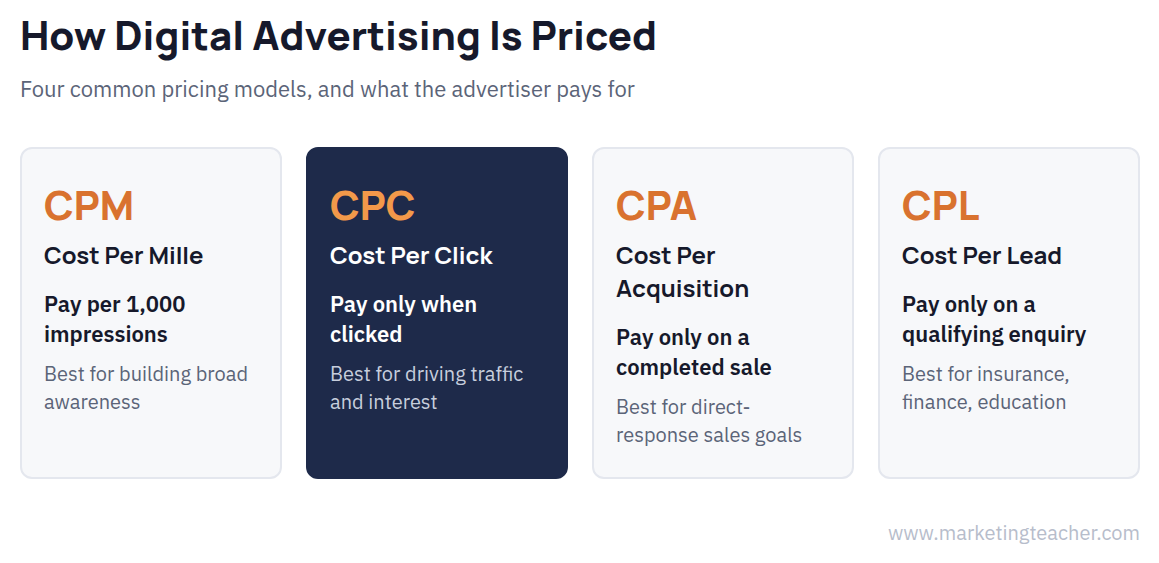
Unlike traditional advertising, where an advertiser typically pays a fixed rate for a fixed placement, most digital advertising is bought and priced against a specific unit of activity, which makes cost directly comparable across very different formats and platforms (Chaffey and Ellis-Chadwick, 2019). Cost per mille, or CPM, charges a set rate for every thousand times an advert is shown, and suits campaigns where the main goal is building awareness rather than an immediate response. Cost per click, or CPC, charges only when someone actually clicks the advert, shifting the risk of an uninterested audience away from the advertiser and onto the platform. Cost per acquisition, or CPA, goes a step further and charges only when a click actually converts into a sale or sign-up, which is attractive to advertisers but commands a higher price per event since the platform is absorbing more of the risk. Cost per lead, or CPL, is a variation on CPA used when the desired action is a qualifying enquiry rather than a completed sale, common in sectors such as insurance or higher education.
Choosing Formats and Pricing to Fit the Goal
The right combination of format and pricing model depends on what a campaign is actually trying to achieve. A brand awareness goal generally favours formats and pricing bought on impressions, such as CPM display advertising, since the aim is simply to be seen by as many of the right people as possible. A direct response goal, such as generating sales or sign-ups, generally favours formats and pricing tied to an action, such as CPC or CPA advertising through paid search or paid social, since spend is only committed once a user has shown genuine intent. Many campaigns combine both: a CPM display campaign builds awareness of a product, while a CPC paid search campaign captures the resulting demand from people who go on to search for it directly. Digital advertising is only one part of a business’s wider communications activity; how it fits alongside owned and earned channels is covered in the dedicated Digital Marketing Communications lesson.
Summary
Digital advertising is the practice of paying for placement across online channels such as display, paid search, and paid social, distinct from the earned and owned channels covered elsewhere on this site (Chaffey and Ellis-Chadwick, 2019). What makes it distinctive is how it is priced: CPM for impressions, CPC for clicks, and CPA or CPL for completed sales or leads, each suited to a different kind of campaign goal. Choosing the right combination of format and pricing model, and knowing how digital advertising fits alongside a business’s owned and earned channels, is central to using an advertising budget effectively.

